International Tour Company vs Local Tanzania Safari: How Prices Compare
The obvious choice isn’t always the best value: booking directly with a Tanzania-based operator can reduce intermediary costs, but it doesn’t automatically make a safari cheaper. When comparing an international tour company with a local Tanzania safari operator, compare the complete trip: the same parks and safari days, accommodation category, transport, meals, fees, flights, and transfers. An overseas agent may sell the safari while a Tanzania-based company arranges the vehicle, guide, and local services.
There’s more to weigh than the headline price. Private arrangements, written booking details, payment terms, and group size can all shape your experience, from planning to time in the wilderness. This guide explains how to compare like for like, understand the trade-offs between booking routes, and decide which option suits your priorities. With the details clear, you can choose a safari shaped around your preferred pace, comfort, and way of experiencing Tanzania.
Key Takeaways
- Compare quotations on the same parks, safari days, accommodation, transport and inclusions to see where the real value lies.
- Consider whether a private vehicle and a more adaptable daily schedule matter more to you than sharing a safari with other travelers.
- Clear written itineraries, payment details and booking arrangements help you understand who is responsible for each part of your trip.
- Think about the atmosphere you want in the wilderness, then choose a safari format that fits your preferred pace and group size.
Is Booking Directly With a Local Tanzania Tour Operator Cheaper?
Booking directly with a Tanzania operator can reduce intermediary costs, but the final price depends on parks, safari days, accommodation, transport, group size, and inclusions. The advantage is a closer booking relationship; the trade-off is that you need to compare the complete package, not just its headline price.
Direct Booking Costs
An overseas travel agent may sell a safari while a Tanzania-based company provides the vehicle, guide, accommodation coordination, and local services. Direct booking can remove an intermediary, but it doesn’t guarantee a lower total. Tanzania safari costs are influenced by park fees and the distances involved. Compare the same parks, safari days, transport type, meals, fees, flights, and transfers before judging value.
Accommodation Choices and Costs
Accommodation category can change the overall quotation as much as the route. A Serengeti itinerary with remote lodges inside or near parks differs from one using another accommodation category, even when the safari days match. Compare named stays, room categories, meal plans, and transfers wherever those details are provided. A lower headline price may reflect different lodging or inclusions, rather than a cheaper equivalent stay.
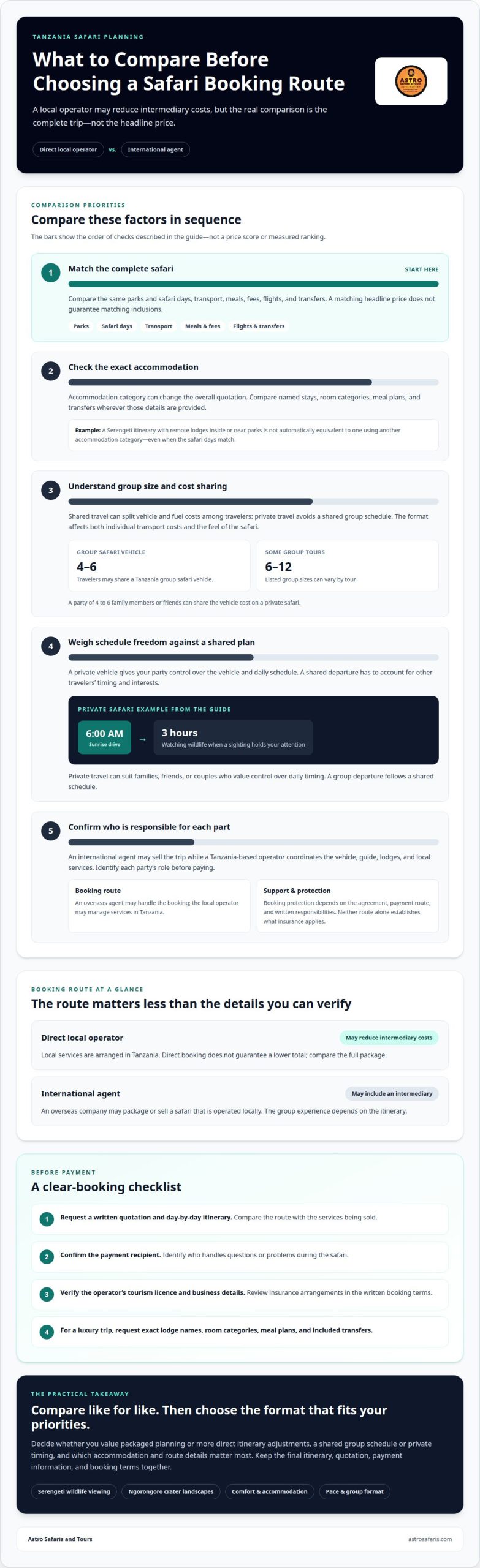
Group size also shapes cost and atmosphere. A Tanzania group safari vehicle may carry four to six travelers, while some group tours list sizes of 6-12 people. Shared vehicle and fuel costs can be split among six people; on a private safari, a party of 4 to 6 family members or friends can share the vehicle cost. Sharing can lower individual transport costs, while private travel avoids a shared group schedule.
| Booking option | Price structure | Package comparison | Group experience |
|---|---|---|---|
| Direct local operator | May reduce intermediary costs | Local services arranged in Tanzania | Shared or private formats |
| International agent | May include an intermediary | May sell a locally operated safari | Depends on the itinerary |
First match every inclusion, then weigh the total against your preferred accommodation and group format.
Which Option Is Better for a Private Tanzania Safari?
For a first Tanzania safari, pairing Serengeti wildlife viewing with Ngorongoro’s crater landscapes offers two distinct settings. The better booking route depends on how much schedule flexibility and coordination you want.
Itinerary Flexibility and Coordination
An itinerary connects parks, overnight stays, and travel times. A private plan can be shaped around your interests, while a group departure follows a shared schedule. Tanzania’s parks are spread out, so routing matters: changes can affect driving time, lodge nights, or whether a domestic flight fits. An international agent may package the journey, while local coordination can make route decisions more direct.
Wildlife Viewing Pace
A private safari vehicle gives your party 100% control over the vehicle and daily schedule. You could plan a 6:00 AM sunrise drive, then spend three uninterrupted hours watching wildlife when a sighting holds your attention. A shared departure has to account for other travelers’ timing and interests, which can mean less freedom to linger or change the day’s pace.
For a first visit, Serengeti and Ngorongoro create a varied route, but the order and time spent in each park shape the experience. Decide whether your priority is extensive wildlife viewing, crater scenery, or a balanced mix. Then align overnight stops and travel days with that priority, rather than adding destinations without considering the distances between them.
Private travel suits families, friends, or couples who value control over daily timing. It also makes itinerary coordination important: long drives across Tanzania can affect when you arrive and how much time remains for a game drive. An overseas company can simplify package planning; a local operator can coordinate the safari on the ground. The right fit depends on whether packaged planning or more direct itinerary adjustments matter most to you.
Consumer protections and booking arrangements
Booking protection depends on the agreement, payment route, and responsibilities set out in your safari arrangements. An international agent may sell the trip while a Tanzania-based operator coordinates the vehicle, guide, lodges, and local services, so identify each party’s role before paying.
Communication can follow the same structure. An overseas agent may handle your booking, while the local operator manages services in Tanzania. Find out who will assist if a vehicle, lodge, or transfer problem arises during the trip. Clear responsibility matters more than assuming either booking route automatically provides stronger support.
Licensing and insurance are separate checks. Before payment, verify the operator’s tourism licence and business details, then review insurance arrangements in the written booking terms. Booking through an international company or a local operator alone doesn’t establish what insurance applies.
Use these practical checks before confirming:
- Request a written quotation and a day-by-day itinerary, then compare the route with the services being sold.
- Confirm the payment recipient and identify who handles questions or problems during the safari.
- For a luxury trip, request exact lodge names, room categories, meal plans, and included transfers.
These details make omissions easier to spot. For example, a quotation naming Serengeti lodges but leaving room categories unclear may not define the stay you expect. A day-by-day itinerary also shows how the vehicle, park visits, and overnight stops fit together, helping you understand what the package covers.
Keep the final itinerary, quotation, payment information, and booking terms together. If an international agent and local operator both appear in the arrangement, record which one coordinates each service and whom to contact for assistance. That written record gives you a clearer basis for resolving misunderstandings than relying on verbal assurances alone.
Crowds and safari atmosphere
A safari’s atmosphere depends on more than whether an international company or Tanzania operator books it. Your vehicle arrangement, route, and daily schedule shape how you experience the Serengeti and other parks. Booking locally doesn’t make a park empty, and booking overseas doesn’t automatically mean a crowded game drive.
A private safari for 1-6 people keeps your vehicle and daily schedule within your party’s control. A shared departure means coordinating with fellow travelers, so time at a wildlife sighting and the day’s rhythm may reflect group preferences. Choose private travel for a more personal pace, or shared travel if you welcome company on the road.
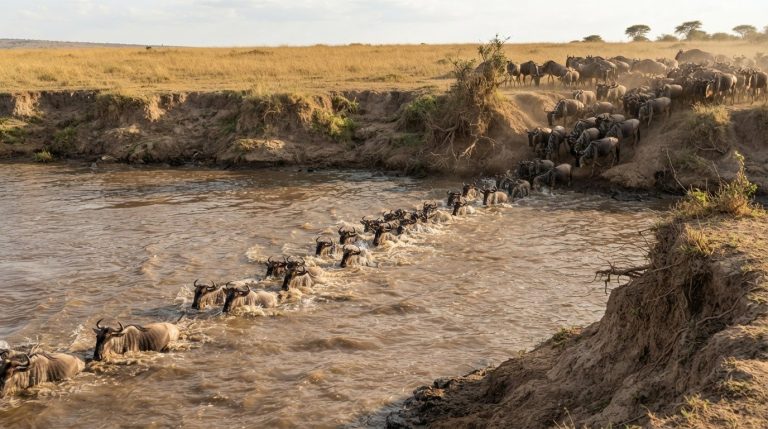
Scale matters. The Serengeti covers nearly fifteen thousand square kilometers, and its migration moves across the ecosystem in different seasons. Wildlife viewing therefore changes with location and season, not simply with the company that arranged the safari. A route designed around your interests can shape which landscapes you visit and how your days unfold.
At a popular sighting, several vehicles may gather, whatever the booking route. Tanzania’s national parks prohibit off-road driving, so a private vehicle doesn’t mean driving beyond permitted routes to avoid other visitors. The difference lies in your schedule and travel party, not a promise of exclusive wildlife encounters or uncrowded parks.
For a quieter-feeling experience, prioritize a private vehicle, a considered route, and a pace that leaves room to observe without rushing between sightings. Review the day-by-day itinerary and where each overnight stop sits in relation to planned park visits. These choices can make the journey feel more personal, even when wildlife viewing areas are shared.
Explore a safari itinerary shaped around your preferred pace and the landscapes you most want to experience.
Astro Safaris and Tours
Astro Safaris and Tours Ltd helps travelers shape a Tanzania itinerary around their priorities. If you want local coordination, private travel, or a route built around particular parks, its options include Serengeti and Ngorongoro, Tarangire and Lake Manyara National Park, and custom safaris in Tanzania.
Choose a route by weighing your preferred pace, accommodation style, and time across the parks. For a more elevated stay, the Ndutu & Ngorongoro Luxury Tour offers a distinct option. Each itinerary gives you a practical starting point for deciding how you want to experience Tanzania’s wilderness, rather than choosing solely by the booking company’s location.
Contact Astro Safaris and Tours Ltd to discuss the safari experience that best fits your plans.
Shape the Safari Around What Matters Most
The choice between an international tour company and a local Tanzania safari operator ultimately comes down to how you want your journey to feel. Let your priorities lead: time in the wilderness, the parks you hope to experience, and the comfort and pace that suit your travel party. A clear starting point makes it easier to turn a broad dream into a purposeful route.
Astro Safaris and Tours Ltd offers journeys through Tarangire and Lake Manyara National Park, Serengeti and Ngorongoro, and Tarangire, Lake Manyara and Ngorongoro Crater. Use these park combinations as starting points for deciding which landscapes belong in your own story. The right itinerary brings your interests together in a considered way, without rushing.
When you’re ready to explore the possibilities, contact Astro Safaris and Tours Ltd to discuss your Tanzania safari plans. Let the next step be the beginning of a journey shaped around the wild places you’re most eager to discover.
Frequently Asked Questions
Local Tanzania Tour Operator vs Overseas Travel Agent: Which Is Better for Your Safari?
Neither is automatically better; choose according to the kind of planning support you value. A local operator may suit travelers who want trip decisions handled close to the safari setting. An overseas agent may suit those who prefer coordinating their holiday through a company based in their home market. In either case, focus on who will deliver each part of the itinerary.
How Can You Safely Choose Between a Local Operator and an Overseas Agent?
Choose an arrangement with a clear written record of responsibilities and changes. Before committing, make sure the itinerary identifies the operator, seller, and services each party coordinates. Keep the final quotation, booking terms, and payment confirmation together. For example, if an agent sells a trip operated locally, you should be able to tell which contact handles an itinerary change and which handles an issue during the safari.
Is It Safe to Book a Tanzania Safari Directly With a Local Operator?
Direct booking can be a sound option when the operator’s identity, business details, and booking terms are clear. Check that the written itinerary matches the services being arranged, and understand the payment recipient and contact route for trip problems. Direct booking doesn’t, by itself, establish what insurance applies or guarantee a particular experience, so read the written terms before paying.
Tanzania Safari: Local vs International Companies, What’s the Real Difference?
The main difference is where you arrange the trip, not necessarily where the safari takes place. An international company can sell a Tanzania itinerary, while a local operator can coordinate its delivery on the ground. For a journey combining a safari with another holiday component, clarify which company handles each section. That makes handoffs easier to understand if plans change between destinations.
What Are the Advantages of Booking Through an Overseas Travel Agent?
An overseas agent can offer a familiar point of contact for planning a Tanzania trip from abroad. This may be useful if you want one booking conversation to cover itinerary preferences and the overall travel plan. The agent may still rely on a Tanzania-based operator for safari services, so understand how questions are passed between them and who manages each part of your arrangements.
What Are the Differences Between International Tour Companies and Local Tanzania Safari Operators?
International companies generally sell or coordinate trips for travelers abroad; local operators arrange safari services in Tanzania. The same itinerary may involve both, so the useful distinction is each party’s role. For example, identify who handles booking amendments, who coordinates accommodation, and who supports you during the safari. Clear responsibilities help you choose the arrangement that fits your preferred planning style.