The Great Migration in the Serengeti: Seasons, Crossings and Cost
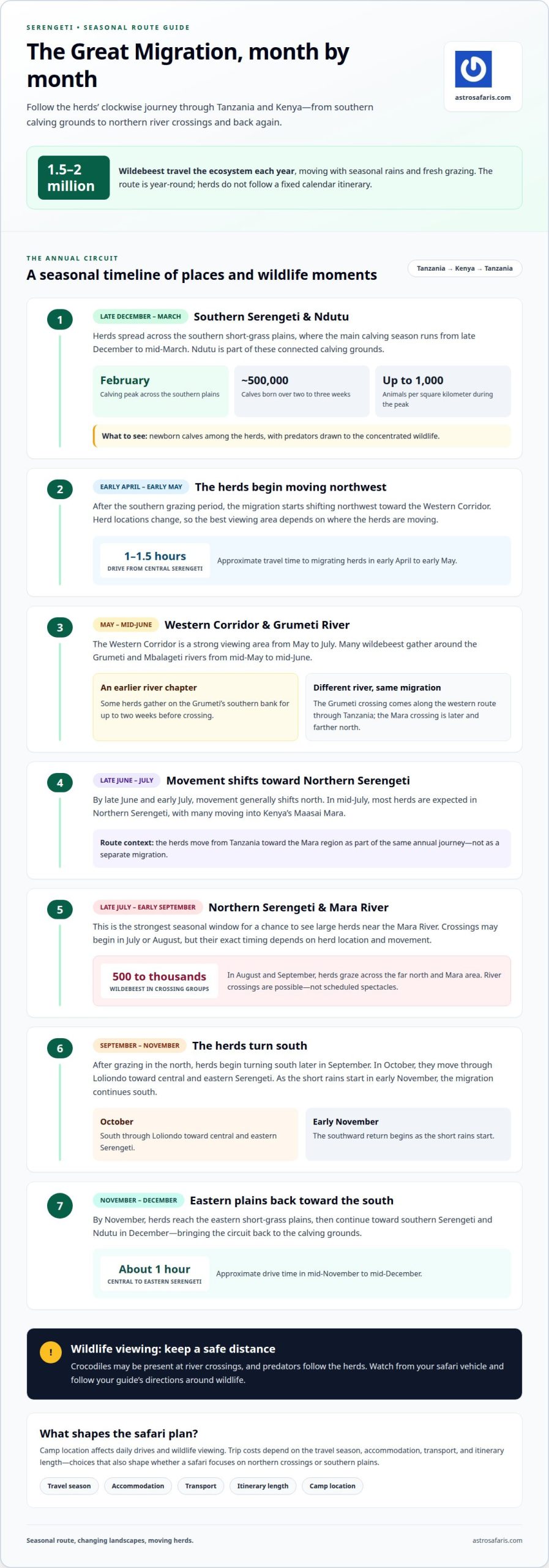
The migration has no single season or fixed address. The great migration in the Serengeti is a year-round journey, with roughly 1.5 to 2 million wildebeest moving across the ecosystem in search of fresh grazing and water. The herds gather in the south for calving, then travel north, where Mara River crossings may unfold from late July to early September.
If you’re picturing one dramatic crossing, it’s easy to see why the great migration Serengeti safari inspires excitement. But the best place to see the herds depends on when you travel. This guide follows their seasonal route, explains how calving and river crossings fit into the cycle, and outlines what shapes safari costs without quoting a tour price. It also gives a practical sense of travel time from Central Serengeti to key migration areas, helping you match your plans to the landscapes and wildlife moments you most want to experience.
Key Takeaways
- Follow the seasonal route from the southern plains through the Western Corridor and north, using the month of your visit to choose a region.
- February is the calving peak around Ndutu, when the southern plains become a vivid stage for newborn wildebeest and predator activity.
- Mara River crossings are seasonal events, not scheduled spectacles; learn how timing and herd movement shape where to look.
- Plan around changing drive times: Central Serengeti is about an hour from Eastern Serengeti in mid-November to mid-December, and about 1 to 1.5 hours from migrating herds in early April to early May.
Serengeti Great Migration 2025/26: When, Where & Cost
Roughly 1.5 to 2 million wildebeest travel the Serengeti ecosystem each year. Their clockwise route follows rain and fresh grazing through Tanzania and Kenya.
The Western Corridor is a strong viewing area from May to July, while the northern Serengeti and Mara region draw herds from July through October. For southern plains and calving, look to Ndutu and the southern Serengeti from January through March.
Wildlife risks include crocodiles at river crossings and predators near the herds. Stay in your safari vehicle and follow your guide’s directions around wildlife.
The Annual Route Through Tanzania and Kenya
The migration follows a clockwise, year-round circuit from Tanzania’s Ngorongoro Conservation Area through Serengeti National Park toward Kenya’s Maasai Mara. Because herds move with seasonal rains, a safari’s location can matter as much as its travel dates. After reaching the north, herds begin moving south again in early November as the short rains start.
Wildebeest, zebras, and gazelles travel together across the Serengeti-Mara ecosystem. Although the route crosses national borders, the herds move across the landscape rather than following a fixed calendar itinerary.
Seasonal Locations and Viewing Opportunities
Each seasonal location offers a different way to experience the migration. From May to July, the Western Corridor is a recommended area for large herds. By late June and early July, movement generally shifts toward Northern Serengeti. Since the exact location varies each year, choosing a region for the season helps shape your safari plan.
In August and September, herds graze in Northern Serengeti and the Mara area, where river crossings are possible. In October, they move south through Loliondo toward central and eastern Serengeti. By November, herds reach the eastern short-grass plains, then move toward southern Serengeti and Ndutu in December.
Safari camps along this route are spread across different regions, so camp location affects daily drives and wildlife viewing. Trip costs depend on factors such as travel season, accommodation, transport, and itinerary length. These choices also determine whether a safari focuses on the northern crossings or southern plains.
Calving season in the southern Serengeti and Ndutu
Calving brings a concentrated pulse of new life to the southern plains. February is the peak, when vast herds spread across open grassland.
Calving in the Southern Serengeti
The southern Serengeti’s short-grass plains host the main wildebeest calving season, typically from late December to mid-March. This timing is important for visitors hoping to witness births and see newborn calves moving among the herds.
In February, approximately 500,000 calves are born over two to three weeks. During the calving peak, many calves are born within a short period. Herds may gather at densities of up to 1,000 animals per square kilometer, creating a remarkable concentration across the plains.
Calving happens within a relatively brief window, but the surrounding landscape is part of a larger seasonal cycle. After the southern grazing period, herds begin moving northwest from early April to early May. Staying four to five nights in the Serengeti gives visitors a reasonable chance of seeing the migration in action.
Calving in Ndutu
Ndutu’s open plains are part of the southern calving grounds and connect with the wider southern Serengeti. The seasonal spectacle is not confined to a single point: herds use nearby grasslands as they follow fresh grazing.
Most calves arrive within a two-to-three-week window around February. Newborns attract predators, while the herds’ close movement across the plains reveals the relationship between grazing, births, and survival.
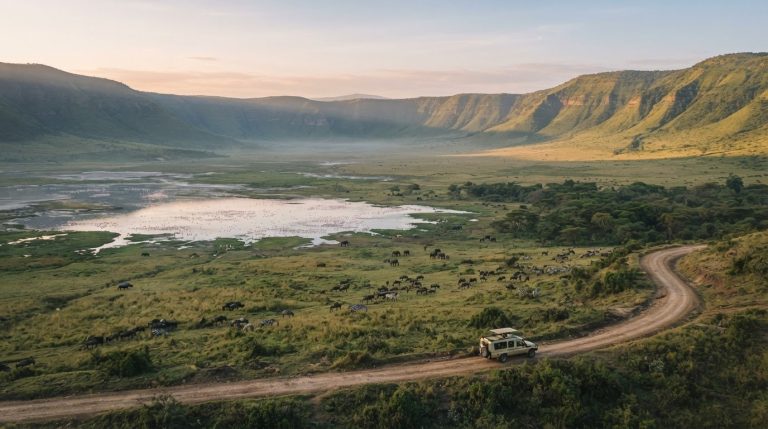
Late December through March suits a safari focused on the southern plains, with February at the heart of calving. A Ndutu and Ngorongoro itinerary can connect the calving grounds with the crater landscapes, pairing wildlife viewing with a change of scenery.
Mara River crossings
River crossings are dramatic moments in a longer seasonal journey, not separate migrations. Herds move north through Tanzania before reaching the Mara region.
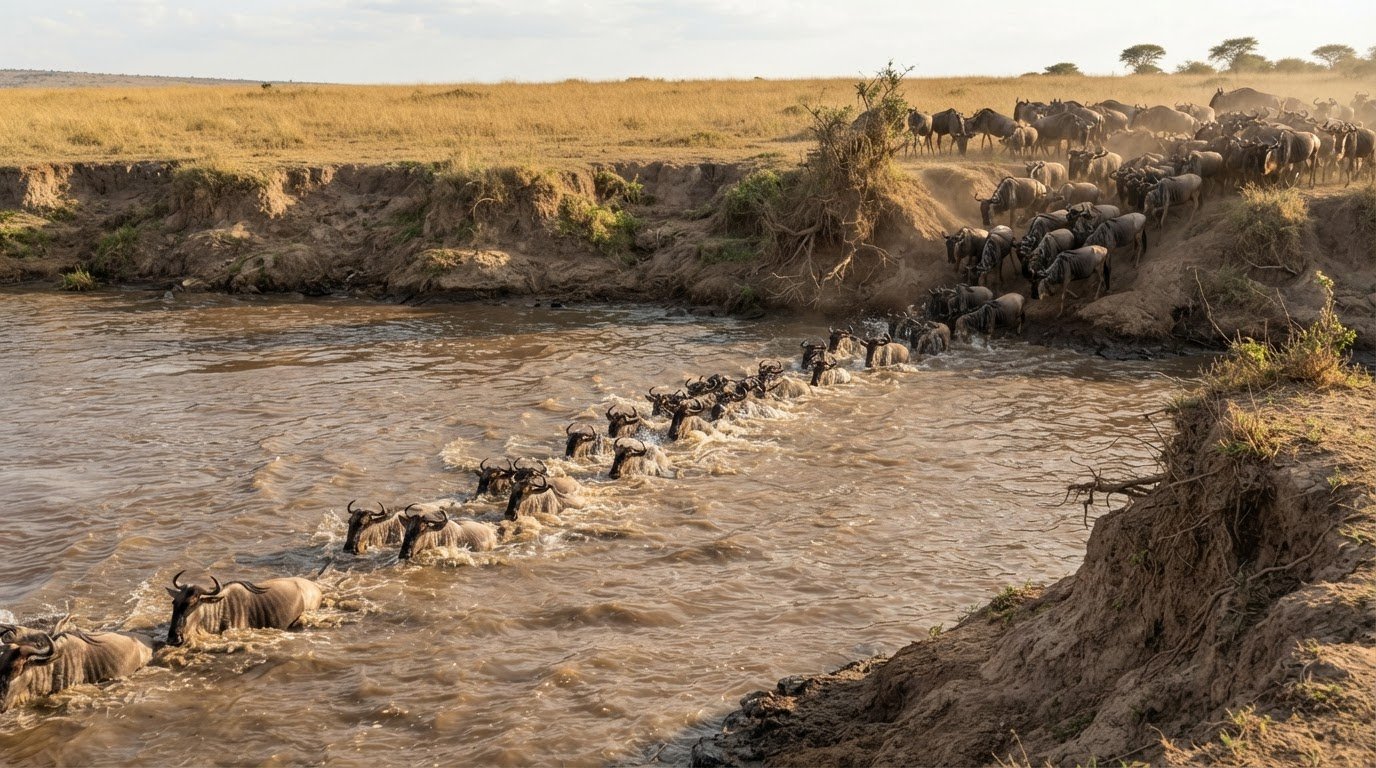
For the best chance of seeing large herds near the Mara River, plan for late July to early September. Crossings begin in July or August, but herd location and movement determine when any individual crossing happens.
In mid-July, most herds are expected in Northern Serengeti, with many moving into Kenya’s Maasai Mara. Groups crossing the Mara can range from 500 to thousands of wildebeest. From August into September, the herds graze across the far north and Mara area before turning south later in September.
The Western Corridor offers an earlier river-crossing chapter. In June, migrating herds gather there before crossing the Grumeti River, and many remain around the Grumeti and Mbalageti rivers from mid-May to mid-June. Some wildebeest gather on the Grumeti’s southern bank for up to two weeks before crossing. By July, some have crossed and continue north toward the Mara River.
These two rivers mark different stages of the same migration. The Grumeti lies along the westward route through Tanzania; the Mara crossing comes later, in the northern Serengeti and across the Kenya border. If the Grumeti stage is your priority, a Grumeti Wildebeest Safari focuses on that stretch of the journey.
Kenya’s Maasai Mara migration season is the northern phase of the same annual movement, not a separate migration. Herds typically reach the Mara region in late July or August and graze there through the dry season, with some moving between Kenya and Northern Serengeti.
Riverbanks bring wildlife close together, including crocodiles waiting in the water and predators following the herds. Watch crossings from your vehicle and follow your guide’s directions. Keep a respectful distance from wildlife and never approach the riverbank on foot.
Travel times from central Serengeti to migration areas
The best way to plan travel is to match your Serengeti base to the herds’ seasonal location. From Central Serengeti, Eastern Serengeti is about one hour away in mid-November to mid-December, while migrating herds are about 1 to 1.5 hours from Central Serengeti camps in early April to early May.
These time estimates describe different journeys. The November figure is a distance east from Central Serengeti, while the April-to-May estimate describes camps in relation to the migrating herds. A camp can be near a region even as the animals’ position within it changes.
In early April to early May, herds move from Ndutu and South Serengeti toward the northwest. Central Serengeti camps can provide access during this transition, with the stated 1 to 1.5-hour road journey offering a practical reference for safari planning. The exact location of the herds shifts as they move.
By mid-November, most herds can generally be seen in Eastern Serengeti, about one hour east of Central Serengeti. They then continue farther south over the following 30 days. For a November itinerary, that pattern makes the eastern side a useful focus before the herds return toward the short-grass plains.
Plan your route to the Serengeti around the region and season you want to experience. A Tanzania itinerary may connect Ngorongoro with Central Serengeti, then allow time to travel toward seasonal wildlife areas. Central Serengeti is a useful reference point, not a guarantee that you’ll be beside the herds.
For a tailor-made route through Tanzania, plan a Serengeti migration safari around the seasonal locations and these central-to-regional travel times. Africa’s open distances are part of the journey, so allow your itinerary to follow the landscape rather than treating the migration as a fixed point.
Choose your Serengeti base according to the herds’ seasonal position: Central Serengeti offers access during their April-to-early-May northwest movement, while the eastern side is useful in mid-November. A route from Ngorongoro through Central Serengeti can leave time to continue toward seasonal wildlife areas.
Astro Safaris and Tours
Astro Safaris and Tours Ltd can shape a Tanzania itinerary around the migration regions and wildlife experiences you want to prioritize. Since the herds move through different parts of the Serengeti throughout the year, choosing where to stay and how to connect destinations is central to planning.
A Serengeti and Ngorongoro itinerary can pair migration viewing with time in the crater region, while the Ndutu & Ngorongoro Luxury Tour suits travelers drawn to the southern plains and calving season. The right route depends on your travel dates, preferred safari style, and interest in particular stages of the migration.
Share when you hope to travel and what you most want to see, whether calving, open-plains herds, or river crossings. Contact Astro Safaris and Tours Ltd to plan your Tanzania safari itinerary.
Shape the Safari Around Your Story
Let your travel dates be the start of a more personal Tanzania journey. The great migration in the Serengeti can be the heart of your plans, with the route and pace shaped around the landscapes and wildlife you value most. Think beyond a single sighting and consider how the wider journey can reveal the country’s varied scenery.
Astro Safaris and Tours Ltd offers Serengeti and Ngorongoro, Tarangire and Lake Manyara National Park, and Tarangire, Lake Manyara and Ngorongoro Crater itineraries. These options let you pair migration-focused days with other memorable landscapes, rather than treating each destination as a separate trip.
When you’re ready to turn that idea into a route, contact Astro Safaris and Tours Ltd to discuss a Tanzania safari shaped around your interests. The open plains are waiting, and your own story there can begin with a thoughtful plan.
Frequently Asked Questions
Can I see the migration year-round?
Yes. The herds keep moving through the Serengeti ecosystem throughout the year, so the experience changes with their location. A trip outside the crossing season can still bring sightings of migrating animals, though the focus may shift to grazing herds or calving rather than river action. Decide which scene matters most, then choose your travel dates and safari region accordingly.
Do I need to go to Kenya to see the river crossings?
No. You can look for river crossings in Tanzania’s Northern Serengeti and around Kenya’s Maasai Mara. The herds move across the border as part of one connected journey, so a Tanzania-based safari can include the northern migration landscape. Your destination within the region matters more than crossing an international border simply to seek a river spectacle.
How Much Does a Migration Safari Cost?
A migration safari’s price depends on the trip and is provided after a quote request. Key cost factors include travel season, accommodation style, transport, itinerary length, and the regions connected by the route. A stay focused on one migration area differs from a broader Tanzania journey. Start by deciding which wildlife experience and comfort level matter most, as these choices shape your overall budget.
Is the Great Migration only in Tanzania?
No. The Great Migration moves through the Serengeti ecosystem across Tanzania and Kenya, with herds following seasonal grazing and water. The country you visit determines which part of the journey you see, not whether you are seeing a separate migration. For a Tanzania trip, focus on Serengeti regions that align with your travel dates and interests.
When to visit?
Choose your travel period based on the experience you want: the southern plains for calving, the Western Corridor for herds moving north, or Northern Serengeti for the Mara River stage. If your dates are fixed, shape the route around the region that fits that period rather than expecting the herds to stay in one place. A flexible itinerary can help accommodate seasonal movement.
Why do wildebeest migrate?
Wildebeest migrate in search of fresh grazing and water, following seasonal rainfall across the Serengeti ecosystem. Their movement is part of a wider cycle involving zebras and gazelles, whose grazing patterns also respond to changing conditions on the plains. The route is a living response to the landscape, not a fixed procession that reaches each region on an exact schedule.