


How to Plan a Tanzania Safari: A Thoughtful Step-by-Step Guide
What if the best Tanzania safari isn’t the one with the most parks, but the one that gives each place time to make an impression? If you’re wondering how to plan a Tanzania safari, the choices can feel immense: the Serengeti’s wide horizons, Ngorongoro’s dramatic crater, Tarangire’s elephant country, and decisions about when to go and how much time to allow. Trying to fit everything in can leave too little space to enjoy the journey.
A thoughtful plan starts with what matters most to you. Your travel dates, wildlife interests, available days, preferred pace, and comfort level can shape a route that feels rewarding rather than rushed. Whether you prefer a private or group safari, and budget, mid-range, or luxury travel, each decision should support the experience you want.
This guide will help you compare seasonal considerations, choose destinations, and set a realistic pace for your trip. It also covers practical preparations, so you can turn a long list of possibilities into a clear, personal plan.
Key Takeaways
- Start with your wildlife and travel priorities, then use them to guide your dates, pace, and route.
- Compare seasonal conditions with your priorities, while remembering that wildlife sightings are never guaranteed.
- Choose a manageable number of destinations for your available time before building a day-by-day itinerary.
- Plan your route and practical travel details together to make the journey feel coherent.
- A tailor-made guided safari can bring your interests, preferred pace, and comfort level together.
How to Plan a Tanzania Safari Around Your Priorities
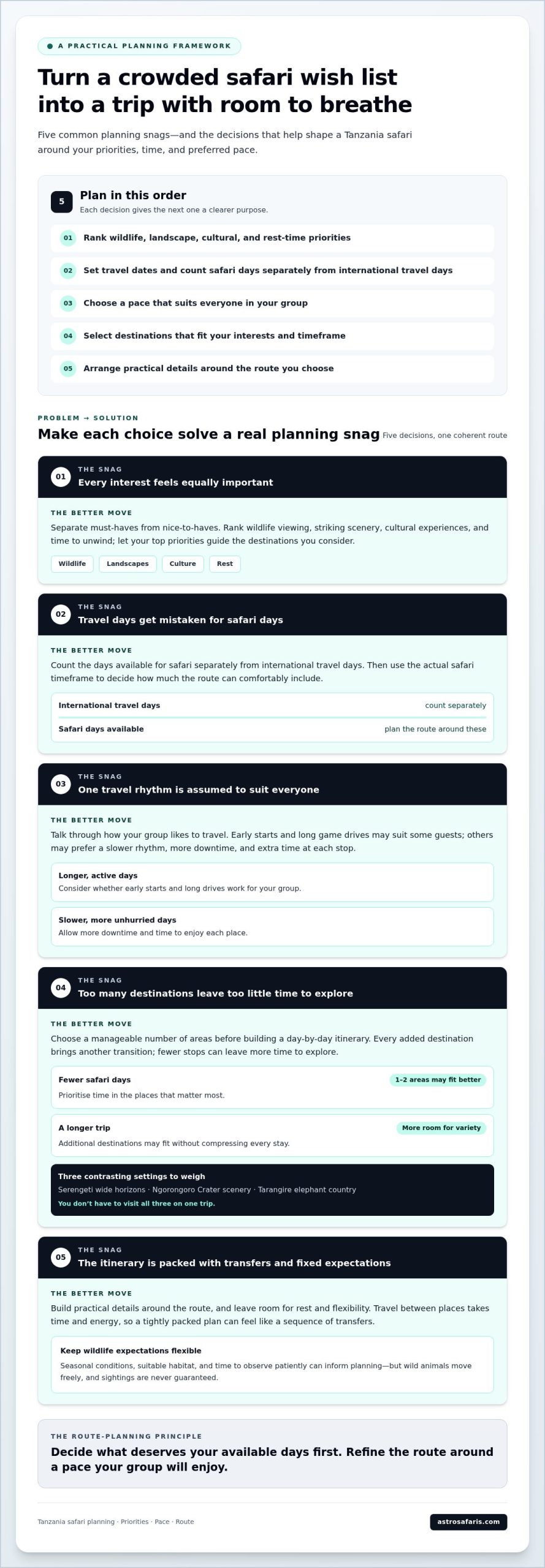
Begin with what you hope to experience, not a map crowded with parks. The clearest way to understand how to plan a Tanzania safari is to make decisions in order: define your priorities, set your dates, choose your pace, shape a route, and then organise the practical details. Start by counting your safari days separately from international travel days, and consider who is travelling. A couple hoping for long game drives may want a different rhythm from a family that needs more downtime.
Use this five-step sequence as your starting point:
- Rank your wildlife, landscape, cultural, and rest-time priorities.
- Set your dates and count the safari days available.
- Choose a pace that suits everyone in your travel group.
- Select destinations that fit your interests and timeframe.
- Arrange the practical details around the route you choose.
Start with the safari experience you want
Separate must-haves from nice-to-haves before choosing parks. You might prioritise wildlife viewing, striking scenery, cultural experiences, or a quieter holiday with time to unwind. Rank these interests instead of treating them as equally important. Your top priorities can guide the destinations you consider; the others can help you decide how to balance the trip.
- Wildlife: Think about the habitats and viewing experiences you’d like, rather than expecting a particular animal encounter.
- Landscapes: Decide whether open plains, crater scenery, or varied environments appeal most.
- Culture and rest: Set aside time for local experiences and unhurried moments, if these matter to you.
Tourism in Tanzania includes safaris among its varied attractions, as outlined in this overview of tourism in Tanzania. Let your interests narrow the options, but don’t treat them as promises. Wild animals move freely, and sightings can’t be guaranteed. A thoughtful plan considers suitable habitat, seasonal conditions, and time to observe wildlife patiently.
Set a realistic timeframe and travel rhythm
Count the days you can spend on safari separately from your international travel days. Then think about how your group likes to travel. Early starts and long drives may suit some guests, while others prefer a slower rhythm and more time at each stop. These preferences affect how many destinations make sense.
Every added destination brings another transition. Serengeti, Ngorongoro Crater, and Tarangire offer contrasting settings, but you don’t have to visit all three on one trip. With fewer safari days, choosing one or two areas can leave more time to explore. A longer trip may allow you to add variety without compressing every stay.
Leave room in the schedule for rest and flexibility. Travel between places takes time and energy, and a tightly packed plan can make the experience feel like a sequence of transfers. Decide what deserves your available days first, then refine the route around a pace your group will enjoy.
Choose When to Visit Tanzania Based on Wildlife and Travel Priorities
Dates shape more than the weather. Seasonal conditions can change the appearance of the landscape, travel conditions, and where wildlife is found. Conditions also vary between regions, so the best fit for one area may not be the best fit for another. Treat the calendar as one planning tool, then consider it alongside your priorities and chosen destinations.
Match seasonal conditions to your safari priorities
Start by deciding what matters most: travel conditions, greener scenery, or a particular wildlife experience. Broad seasonal patterns can help you compare options, but they aren’t a park-by-park forecast. Use the table as a starting point, then get current guidance for the specific areas and dates in your itinerary.
| Broad period | What to consider |
|---|---|
| Drier conditions | Some travellers prefer firmer travel conditions and more open landscapes. Conditions still vary locally, and wildlife is not distributed uniformly. |
| Rainier conditions | Greener scenery may appeal to photographers and travellers who enjoy a changing landscape. Rain can affect travel conditions, so allow flexibility in your plans. |
| Seasonal transitions | Conditions can shift between areas. Consider how your selected route fits your dates instead of assuming every park follows the same pattern. |
Migration timing is especially variable because herds move in response to conditions across a wide area. If migration is a priority, use current, destination-specific guidance when planning and keep the route adaptable. For broader context on the importance of protecting wildlife and habitats, the African Wildlife Foundation’s work in Tanzania describes conservation challenges and efforts across the country.
Balance peak wildlife hopes with flexibility
Choose a travel window that suits both your comfort with changing conditions and your wildlife interests. Flexible dates can give you more room to shape a route around local conditions, but they can’t ensure a particular encounter. Seasonal timing is a guide, not a guarantee. Wildlife moves freely through natural habitats, and sightings depend on changing factors.
Park choice matters as much as the month. A plan centred on the Serengeti may call for different timing considerations from one that includes Tarangire or Ngorongoro Crater. Think about the whole route: the landscapes you want to see, your wildlife interests, and how flexible your dates can be. This is more useful than choosing a month based on one wildlife highlight.
As you compare dates, write down your priorities and trade-offs: the conditions you’d most enjoy, those you’re willing to accommodate, and any wildlife interest that needs current guidance. Astro Safaris and Tours Ltd creates tailor-made Tanzania safari itineraries around travellers’ preferences and timelines, connecting seasonal considerations with a suitable route and pace.
Shape a Tanzania Safari Itinerary That Fits Your Time
A satisfying route isn’t a checklist of famous names. It’s a considered sequence, with enough time to experience each place and room for the journey between them. Before arranging individual days, choose a manageable number of destinations based on your safari time, travel companions, and the experiences you value most.
Serengeti, Ngorongoro Crater, and Tarangire can each be part of a safari, but they don’t have to appear together. Give each potential stop a clear reason to be on the route, such as a landscape you want to experience or a habitat that complements another destination.
Trip length shapes the route: fewer safari days generally favour fewer stops and more time in each, while a longer stay can allow for additional destinations without compressing every visit.
Choose destinations without overloading the route
Sketch the route before filling in a day-by-day schedule. For each destination, note what draws you there and how it supports your priorities. Then account for transfers. Time spent moving between areas is time not spent on game drives or at your accommodation. A route that looks compact on a map may still involve meaningful travel time, so plan around realistic transitions instead of assuming every day can be filled with activities.
Think about the balance you want. A focused stay can feel more immersive; a multi-stop route can introduce greater variety but brings more transitions and planning complexity. Neither is automatically better. For example, someone drawn to the Serengeti’s wide-open setting may want to devote more of the safari to that region. Travellers keen to experience contrasting landscapes might pair it with Ngorongoro Crater or Tarangire. These are options, not a prescribed itinerary.
Select a safari style that suits your group
The way you travel shapes the feel of the route. A private safari can give an itinerary more room to reflect personal interests and preferred pace. A group safari offers a shared journey shaped around travelling together. Before choosing, consider who’s coming, how much flexibility matters, and what kind of days you’ll enjoy.
Budget, mid-range, and luxury describe different travel styles and comfort preferences, not a universal checklist of features. Think about accommodation as part of the overall experience: how important is comfort after a day outdoors, and how does your preference fit the rest of the trip? Combine that answer with your preferred pace and group format so the route feels consistent.
As you work out how to plan a Tanzania safari, write down your available days, the destinations that genuinely interest you, and the travel style that suits your group. Use that shortlist to shape the route, then organise each day around realistic transfers, time in the parks, and the experience you want to take home.
Prepare for Tanzania Safari Logistics Before You Travel
Preparation can make the first day feel calmer and leave you more attention for the landscapes and wildlife around you. Keep logistics connected to your confirmed route. Entry documents, health guidance, packing, communications, and arrival arrangements all depend on your travel dates and plans.
Organise documents and travel arrangements
Before departure, review current passport, visa, and entry guidance through official government sources. Check health guidance with authoritative public-health sources and a qualified medical professional, since requirements and personal advice can change. Keep essential documents accessible, and consider storing secure digital copies separately from the originals.
Plan international flights and travel insurance as separate parts of your preparations. Make sure safari transfer arrangements reflect your confirmed flight details, and keep relevant contact information somewhere you can access during the journey. If your plans include a long transfer or a major connection, allow buffer time where possible. A schedule with breathing room is less vulnerable to delays than one that depends on every leg running perfectly.
Pack for comfort, changing conditions, and wildlife viewing
Build your packing list around the season, route, accommodation, and activities instead of relying on a universal safari checklist. Versatile layers can help you adapt to changing temperatures. Comfortable clothing, sun protection, and personal essentials can support long days outdoors. Keep anything you’ll need during travel easy to reach.
- Documents: Keep travel documents and essential contact details organised and accessible.
- Clothing: Choose versatile pieces suited to your planned activities and expected conditions.
- Sun protection: Pack items such as a hat, sunglasses, and sunscreen that suit your needs.
- Communications: Decide how you’ll access maps, messages, and important information during the trip.
- Luggage: Check the limits for every confirmed transport segment, especially if your route includes different types of transport.
Patience and respect matter when viewing wildlife. Follow your guide’s instructions, keep a considerate distance from animals, and avoid disturbing them. Your guide understands local conditions and safety procedures. Listen carefully, particularly when outside the vehicle or near wildlife.
Use this checklist as a final review while learning how to plan a Tanzania safari. Astro Safaris and Tours Ltd brings route, pace, and comfort preferences together in tailor-made safari itineraries. You can find more details about tailor-made Tanzania safari planning here.
Bring Your Tanzania Safari Plan to Life with a Tailor-Made Journey
A route becomes meaningful when its parts work together: the places you hope to explore, your travel dates, the pace that feels right, and the comfort you prefer at the end of each day. A tailor-made itinerary can turn those decisions into a guided journey shaped around your interests and timeline, rather than a standard route everyone is expected to follow.
Turn your priorities into a considered itinerary
Astro Safaris and Tours Ltd creates guided Tanzania wildlife safaris across Serengeti National Park, Ngorongoro Crater, and Tarangire National Park. These destinations can be considered individually or combined to suit your travel window and priorities. You could devote more time to an area that particularly interests you, or choose a route that brings different landscapes together. The right arrangement depends on your trip, not a universal formula.
Your preferred way of travelling matters, too. Private safaris can suit travellers who value a more personalised experience, while group safaris offer the chance to share the journey. Budget, mid-range, and luxury options provide different approaches to comfort and travel style. Consider these choices alongside your preferred pace and accommodation expectations so the experience feels consistent from one stop to the next.
Thoughtful planning also considers how a journey engages with the places and people encountered along the way. Astro Safaris and Tours Ltd emphasises responsible tourism and authentic local experiences as part of discovering Tanzania. This can add depth to a safari, making the journey about more than the distance travelled or the parks visited.
Choose the next planning step with confidence
Before shaping a final itinerary, bring your decisions into one clear picture: what you most want to experience, when you can travel, how much time you have, what pace suits your group, and which destinations and comfort level feel right. Sharing your preferences and timeline gives a tailor-made plan a useful foundation. It also helps separate essential elements from details you’re happy to leave flexible.
If you’re still deciding how to plan a Tanzania safari, you don’t need every detail settled before considering a guided journey. A clear sense of your priorities is a strong beginning. The route can then bring those interests together while accounting for the practical realities of travel.
Astro Safaris and Tours Ltd offers guided Tanzania safari options, including private and group wildlife experiences. A tailor-made itinerary can reflect your travel style, interests, and available time.
Let Your Safari Story Take Shape
Your first outline doesn’t need to be perfect. Start with a few priorities, a travel window, and a sense of the pace and comfort you’d enjoy. From there, a considered itinerary can bring your ideas together and leave room for the unexpected moments that often become lasting memories.
If you’re ready to take the next step in how to plan a Tanzania safari, Astro Safaris and Tours Ltd can shape guided private or group wildlife experiences around your preferences. Tailor-made itineraries can connect Serengeti, Ngorongoro, and Tarangire with budget, mid-range, or luxury travel styles.
Explore tailor-made Tanzania safaris with Astro Safaris and Tours Ltd and begin planning a journey around the landscapes, wildlife, and pace you value most.
Frequently Asked Questions
Is Tanzania a good destination for a first safari?
Yes, Tanzania can be an excellent first safari destination, particularly if you choose a guided trip that suits your interests and comfort level. A knowledgeable guide can help interpret animal behaviour, landscapes, and the rhythms of a game drive, adding context to what you see. Sightings can’t be guaranteed, so approach each drive with curiosity. If you’re learning how to plan a Tanzania safari, consider what kind of guided experience will help you feel at ease.
Can I combine a Tanzania safari with a Zanzibar beach holiday?
Yes, a mainland safari and a Zanzibar beach stay can be combined in one holiday. Astro Safaris and Tours offers a Serengeti to Zanzibar safari, as well as Zanzibar beach stays. As you shape the trip, decide how much time you want in each setting and how the transition fits your travel plans. Treat the beach as its own part of the journey, with time to slow down after days focused on wildlife.
Do I need travel insurance for a Tanzania safari?
Travel insurance is a separate consideration from your safari arrangements. Review policy terms carefully before travelling, including what they say about medical care, evacuation, trip interruption, and activities in your itinerary. Coverage and exclusions differ between policies, so don’t assume a standard plan includes every situation relevant to your trip. Keep a copy of your policy details and emergency contacts accessible, and make sure the coverage dates match your travel dates.
What should I know about tipping on a Tanzania safari?
Tipping customs can vary, so avoid relying on a single amount as a universal rule. Before departure, review any guidance included with your safari arrangements and decide what feels appropriate for your budget and experience. If you choose to tip, prepare in advance so you’re not making the decision hurriedly at the end of a busy day. A gratuity is a personal gesture of appreciation, not a substitute for respectful communication with your guide and travel team.
Can children join a guided Tanzania safari?
Children may be able to join a guided safari, but suitability depends on their ages, the itinerary, and the rules of the activities and accommodation involved. Consider how they handle early starts, time in a vehicle, and quiet wildlife viewing. A family plan can account for their interests and energy levels, with practical breaks and realistic expectations. Review the specific trip details in advance so the experience is comfortable for both younger travellers and adults.
Is a private safari better than a group safari for a solo traveller?
Not necessarily. The best fit depends on how you want to experience the journey. A private safari can offer an itinerary shaped more closely around your interests and preferred pace, while a group safari gives you the chance to share game drives and experiences with fellow travellers. As a solo guest, consider whether personal flexibility or travelling alongside others matters more to you. Astro Safaris and Tours offers both private and group guided wildlife safaris.
What should I know about photographing wildlife on safari?
Photograph wildlife patiently and respectfully. Follow your guide’s instructions, avoid distracting or disturbing animals, and don’t let the camera take your attention away from the experience itself. Pack equipment you’re comfortable carrying, such as a camera, spare batteries, and storage for images, and keep it protected during travel. You don’t need elaborate gear to make meaningful photographs. Observing carefully and waiting for a natural moment can matter more than capturing every sighting.


