Serengeti and Ngorongoro Safari: What’s Included
A combined Serengeti and Ngorongoro safari package can bring together park fees, accommodation, meals, and guided game drives. Exact inclusions depend on the itinerary and accommodation, so check the meal plan and overnight stops. The journey pairs the Serengeti’s wide-open plains with the dramatic, wildlife-rich setting of Ngorongoro Crater.
Before picturing the adventure, it helps to know the practical details: where you’ll sleep, how game drives fit into each day, and what arrival or departure arrangements involve. These details shape the experience as much as the landscapes.
Here, you’ll learn what to compare in a combined safari package, how game drives fit into the itinerary, and how to plan the practical details. From travel between the parks to the accommodation at each stop, you’ll get a clearer picture of how the journey comes together and which choices suit your priorities.
Key Takeaways
- Compare accommodation, meals, park fees, and transport in the itinerary to understand what your package covers.
- Plan your arrival and departure around the safari’s starting and ending points, with time for the journey to and from Arusha.
- See how a full-day crater drive and a walk along the rim can add different perspectives to the wildlife experience.
- Understand how time in the Serengeti shapes game-drive opportunities and the pace of your trip.
- Explore combined itineraries to see how Serengeti and Ngorongoro fit together, then choose a route that suits your travel style.
Arusha arrival, departure, and accommodation
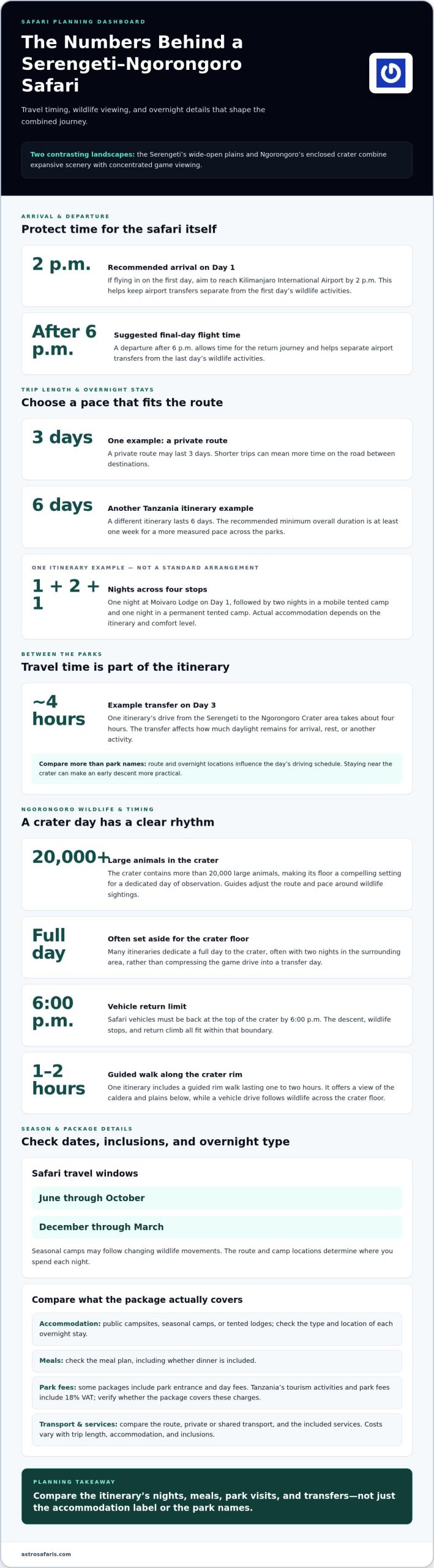
Plan your arrival around the safari’s departure from Arusha, not just your international flight. If flying in on Day 1, the recommended arrival at Kilimanjaro International Airport is by 2 p.m. A final-day departure after 6 p.m. allows time for the return journey. These timings help keep airport transfers separate from the first and last days’ wildlife activities.
Accommodation depends on the itinerary and comfort level, from public campsites to tented lodges. One itinerary example includes one night at Moivaro Lodge on Day 1, followed by two nights in a mobile tented camp and one night in a permanent tented camp. These named stays are examples, not a standard arrangement for every trip.
Seasonal camps can put travelers closer to changing wildlife movements, while permanent tented camps provide a more fixed base. The itinerary determines where you spend each night and how far the camp is from that day’s game-drive area. Before choosing, compare the accommodation type and location, and check which meals are included, including dinner.
Safari length shapes both the route and the number of nights away from Arusha. A private route may last 3 days, while another Tanzania itinerary lasts 6 days; the recommended minimum overall duration is at least one week. A shorter trip can mean more time on the road between destinations, while extra days allow a more measured pace across the parks.
During game drives, follow your guide’s instructions and use the accommodation arranged in the itinerary. Options include public campsites and tented lodges, so check how each overnight stay is described and pack for the setting.
The safari is offered from June through October and from December through March. These travel windows can help you choose dates, while the route and camp locations determine where you spend each night. An itinerary may use seasonal camps to follow wildlife movements across the region.
For a Tanzania safari, plan visa paperwork, vaccination arrangements, and travel insurance separately. Entry documents depend on your passport and route, vaccination advice on your health and travel history, and insurance on the risks you want covered. These preparations are separate from the accommodation and activities in a safari package.
Tour prices vary with trip length, accommodation, private or shared transport, and included services. A camping itinerary and a tented-lodge itinerary can differ in cost because their stays and arrangements are different. The price for a specific safari depends on its route and inclusions. Request a quote, then compare itinerary details rather than judging by accommodation labels alone.
Why is the Serengeti and Ngorongoro Crater an ideal combination?
The Serengeti’s open plains and Ngorongoro’s enclosed crater offer contrasting wildlife experiences. Together, they combine expansive landscapes with concentrated game viewing.
Travel Between the Crater and Serengeti
The transfer links the Serengeti plains with the Ngorongoro Conservation Area, where the scenery rises toward the crater highlands. On one itinerary, the drive from the Serengeti to the Ngorongoro Crater area takes about four hours on Day 3. That travel time matters: it affects how much daylight remains for arrival, rest, or another activity.
Compare the route and overnight locations, not just the park names. Staying near the crater can make an early descent more practical, while a tented camp elsewhere may change the day’s driving schedule. Travel between the regions is part of the safari, but it also takes time away from wildlife viewing.
Crater Game Drives and Wildlife Viewing
A game drive inside Ngorongoro Crater brings you onto a compact wildlife landscape after descending from the rim. The crater contains more than 20,000 large animals, making the floor a compelling setting for a dedicated day of observation. Wildlife moves through its own habitat; the guide adjusts the route and pace around sightings rather than treating every drive as a fixed checklist.
For a broader perspective, consider pairing a game drive with a walk along the crater rim. One itinerary includes a guided rim walk lasting one to two hours, offering time to take in the caldera and the plains below. The activities serve different purposes: a vehicle drive follows wildlife across the crater floor, while the walk offers a view of the landscape from above.
Time at Ngorongoro Crater
Many itineraries set aside a full day to explore the crater floor, often with two nights in the surrounding area. This gives the crater its own focus instead of compressing the game drive into a transfer day. Compare overnight stops with the planned drive, because where you sleep shapes the start and finish of the crater experience.
A full-day drive also has a clear boundary: safari vehicles must be back at the top of the crater by 6:00 p.m. This makes the day’s timing important, from the descent to wildlife stops and the return climb. If the plan includes a rim walk, check how it fits alongside the vehicle outing; the activity should complement the crater drive, not obscure how much time remains for wildlife viewing.
Included services and exclusions
Compare the itinerary’s inclusions with its overnight stays, meals, and park visits. These details show what the package covers and which travel arrangements are separate.
Safari Pricing and Fees
Park entrance and day fees are included in some safari packages. Tanzania’s tourism activities and park fees include 18% VAT. Read the itinerary’s inclusions to see whether the stated package covers these charges.
Package costs depend on the route, duration, accommodation, and included services. A camping itinerary differs from a tented-lodge stay, while adding destinations can change transport and overnight arrangements. Compare the same components across itineraries, including park visits and accommodation, rather than judging by the headline price alone.
Meals and Meal Budget
Meal plans vary. One package includes breakfast, dinner, a picnic lunch, and a bottle of water; another Tanzania itinerary lists 3 breakfasts, 4 lunches, and 3 dinners. Check the day-by-day plan to see which meals are provided on travel days and during time in central Serengeti.
For meals not included in the package, plan around the itinerary and your overnight stops. Dining arrangements at a lodge or camp may differ from those during a day spent travelling between parks. Check the listed inclusions to see which meals you need to arrange separately.
Packages can include overnight accommodation and water during game drives. One package specifies one liter of water per person per day, while another lists breakfast, dinner, picnic lunch, and a bottle of water. These examples show why the exact itinerary matters: package inclusions can differ even when trips visit the same parks.
Use this practical comparison before choosing:
- Park access: Look for park entrance and day fees among the listed inclusions.
- Meals: Match each included breakfast, lunch, and dinner to the itinerary days.
- Accommodation: Identify whether nights are in a public campsite or tented lodge.
- Separate arrangements: Treat international airfare, visas, and travel insurance as separate from safari services.
These distinctions help you understand what a package covers. A Kilimanjaro arrival, for example, does not mean international airfare is part of the safari. Before comparing options, note each trip’s route, accommodation, park fees, meals, and separate travel arrangements. This makes the inclusions clearer and helps you plan the rest of your trip.
Serengeti National Park game drives
Serengeti game drives follow wildlife across broad plains, with each day shaped by the route and season. The itinerary also determines how drives fit around transfers and overnight stops.
Daily Itinerary and Game Drives
On one itinerary, the first day enters Serengeti National Park after crossing the Ngorongoro Conservation Area. The second-day drive begins at 7:00 a.m., giving travelers a full morning for wildlife viewing. Look at the itinerary’s park nights and transfer days together: long journeys between areas affect time available for game drives.
Travelers are advised to spend at least four or five days exploring Serengeti National Park. A shorter route can still include the park, but leaves less time to explore different areas. Check what each day prioritizes: extended game viewing, travel between camps, or visits to other parks.
Great Migration Viewing
The Great Migration moves through the Serengeti ecosystem annually, involving more than a million wildebeest. Where to look depends on herd movements and the route’s location during your travel dates. Choose an itinerary with time in the relevant Serengeti area rather than treating a park visit as a guarantee of seeing migrating herds.
Season matters, but wildlife movement does not follow a fixed daily schedule. The safari is offered from June through October and from December through March. Use these travel windows as a starting point, then compare the route’s Serengeti locations with your migration-viewing priorities.
A combined route can include Tarangire, Serengeti, Ngorongoro, and Lake Manyara. One five-day private mid-range itinerary covers all four, balancing game drives with transfers between national parks. Compare the overnight stops and time assigned to each destination: a broad route means less time in each park than a longer, more focused stay.
Tarangire National Park adds a different wildlife focus, including more than 550 bird species. A night game drive is distinct from a standard daytime outing, so don’t assume it’s included just because Tarangire appears on an itinerary. Look for the activity to be specifically listed and consider how it fits around the day’s drive and camp schedule.
Guides and drivers shape each outing by interpreting animal signs, choosing routes, and managing transfers. On a Serengeti and Ngorongoro safari, check which days focus on game viewing and which involve longer journeys. This helps set realistic expectations for time among wildlife, whether following wildebeest across open plains or travelling toward another national park.
Combined Serengeti and Ngorongoro safari packages
A combined itinerary links Serengeti National Park’s open plains with the Ngorongoro Conservation Area and its crater. Compare the route, overnight stops, and time in each destination, not just the total trip length.
Package lengths reflect different travel styles. One Serengeti and Ngorongoro safari extension lasts 7 days, while a separate itinerary lasts 10 days and starts and ends in Moshi. A longer route can include additional nights or destinations; the itinerary reveals whether added time means more game viewing or more transfers.
For example, a 10-day route may include two nights in a Moshi hotel, two nights in Central Serengeti, and one night in Ngorongoro. Those stops illustrate how an itinerary can distribute nights across the journey. Read each day in order: the park visited, the overnight location, and the next transfer together determine the trip’s rhythm.
Time inside the parks matters as much as the number of destinations. One itinerary includes a six-hour game drive in Ngorongoro Crater, giving wildlife viewing substantial time. The surrounding schedule determines how the vehicle reaches the conservation area and where travelers stay afterward.
Migration-focused routes call for close attention to location and season. Wildebeest move through the ecosystem, so the Serengeti area and travel dates shape the landscapes you visit. Compare the route with your priorities: a broad circuit emphasizes multiple destinations, while a migration-focused plan can spend more time in specific Serengeti areas.
Guides shape each day’s route around wildlife, road conditions, and available time. Transfers can take up part of an afternoon, so check whether a day includes a game drive, travel between camps, or both. This helps you understand how much time is spent watching wildlife rather than travelling through the Ngorongoro Conservation Area.
Health and safety risks include fatigue during long vehicle journeys, dehydration, sun exposure, and getting too close to wildlife. Follow your guide’s instructions, remain in the vehicle during wildlife viewing unless directed otherwise, and bring any personal medicines you need while travelling.
To compare the practical details, review:
- Route: Identify each park and the order of travel.
- Overnights: Match camp or lodge locations to the next day’s activities.
- Game-drive time: Separate dedicated wildlife viewing from transfer periods.
- Migration focus: Consider which Serengeti area the itinerary visits during your dates.
Package price depends on duration, accommodation, transport, and included activities, and is provided after a quote request. If you’re shaping a route around the crater, Serengeti plains, or migration viewing, plan your combined safari itinerary around the places and pace that matter most to you.
Astro Safaris and Tours Ltd: Tarangire and Lake Manyara National Park
Astro Safaris and Tours Ltd helps travelers turn park choices into a Tanzania safari route shaped around their interests. Its Serengeti and Ngorongoro offering pairs these two destinations. For a broader northern circuit, consider Tarangire, Lake Manyara and Ngorongoro Crater; Tarangire and Lake Manyara National Park offers a more focused alternative.
Choose the landscapes and wildlife experiences you want, then consider whether a luxury itinerary in Ndutu and Ngorongoro suits your travel style. These options offer a starting point for shaping a journey around your priorities, with a pace that works between destinations.
Explore your Tanzania safari options by visiting Astro Safaris and Tours Ltd.
Shape the Journey Around What Moves You
The first decision is not simply which parks to visit. Think about the journey you want to remember: long horizons and wildlife tracking, quiet time at camp, or a route through varied landscapes. Let those priorities guide the itinerary, including its pace and the balance between game drives and travel.
Astro Safaris and Tours Ltd offers Serengeti and Ngorongoro for travelers drawn to these iconic destinations. You can also choose Tarangire and Lake Manyara National Park, or combine Tarangire, Lake Manyara and Ngorongoro Crater. Each route offers a different way to experience Tanzania, so start with the places that matter most to you.
When you’re ready to turn that vision into a route, contact Astro Safaris and Tours Ltd to discuss your safari plans. Your next great story begins with the landscapes you choose.
Frequently Asked Questions
What’s included?
A safari package can include guided game drives, transfers, park permits, and accommodation, with meals depending on the itinerary. Compare what happens on each travel day: a picnic lunch may be planned during a park outing, while dinner may be included at camp. Plan for personal purchases and international airfare separately from the safari package.
How much will this safari cost?
The price depends on the itinerary, accommodation, trip length, transport arrangements, and included activities. Private and shared group itineraries can have different arrangements, so compare what each package covers rather than relying on a headline figure. Astro Safaris and Tours Ltd provides pricing after a quote request, based on the route and travel style you choose.
What are the main highlights of this trip?
The defining contrast is between the Serengeti’s far-reaching plains and Ngorongoro Crater’s enclosed landscape. The Serengeti offers expansive wildlife country and the annual wildebeest migration; Ngorongoro provides a dramatic caldera setting for observing animals. Your highlights depend on the route, season, and time spent in each place, so prioritize the landscapes and wildlife experiences that matter most to you.
What are the modes of transportation on my trip?
Expect road transfers between safari destinations and vehicle-based game drives inside the parks. The itinerary determines how much of each day is spent travelling and how much is reserved for wildlife viewing. Adding another park, for example, creates an additional transfer leg. International flights are separate, so plan them independently from the guided safari and its in-country itinerary.
How many days are recommended for a Serengeti and Ngorongoro safari?
Allow at least one week for a more measured visit to both destinations. A shorter itinerary can still combine them: Astro Safaris and Tours Ltd lists a 3 Days / 2 Nights option. The difference is pace. With extra days, you can give each park more attention and reduce the pressure to fit wildlife viewing around transfers. Match the trip length to how much time you want in each landscape.
What is the typical cost of a Serengeti and Ngorongoro safari from the United States?
There isn’t one useful total for every traveler from the United States. Safari costs depend on the route, trip length, accommodation, transport, and included activities; international airfare is a separate expense. A quote for your chosen itinerary gives a more relevant figure than a general estimate, since a short private trip and a longer itinerary with different lodging can have very different arrangements.
How do Serengeti and Ngorongoro compare for wildlife viewing and scenery?
The Serengeti is known for open plains and wildlife moving across a vast ecosystem, including migrating wildebeest. Ngorongoro offers a distinct caldera setting, with wildlife viewed against steep crater walls in a more contained landscape. Choose the Serengeti for a sense of space and changing scenery, or Ngorongoro for dramatic crater panoramas and concentrated game viewing. Visiting both brings these contrasting experiences together.
What are the park entrance fees for Serengeti National Park and Ngorongoro Conservation Area?
Park entrance and conservation fees vary depending on whether you are an adult, child, or resident, and they are typically structured as per-person, per-24-hour rates. In most cases, these fees are already bundled into your tour price when booking a package through Astro Safaris and Tours Ltd. Always check your specific itinerary details to confirm whether park permits and crater service fees are fully included in your quoted total.