4 Things to Watch in Cheetah Hunts on a Serengeti Game Drive
A cheetah’s hunt is a burst, not a prolonged pursuit: Serengeti chases rarely last more than 30 seconds. For anyone watching cheetah hunting behavior on a Serengeti game drive, the crucial moment often begins before the sprint, as the cat edges closer through open grass. At top speed, a cheetah can reach 112 kph (70 mph), but the chase itself is only one part of the encounter.
That brief flash of motion makes a cheetah sighting absorbing, and easy to miss if you look away. This guide explains when cheetahs are easier to spot, which Serengeti landscapes they use to hunt, how their speed and stamina shape a chase, and what happens as they recover. Watch for the signs before the dash and the stillness afterward: together, they reveal the strategy and effort behind one of the plains’ most striking scenes.
Key Takeaways
- Plan drives around the cooler parts of the day, when cheetahs are more likely to be active and scanning for prey.
- Match your travel season to the landscapes where sightings are more likely, from the southern plains during calving season to Namiri Plains in drier months.
- Look for open hunting terrain, where a cheetah can spot prey and use the grass for cover as it closes the distance.
- Learn to read the pause after a chase: a cheetah’s recovery helps explain why the hunt is about more than raw speed.
1. Hunt duration and recovery after a chase
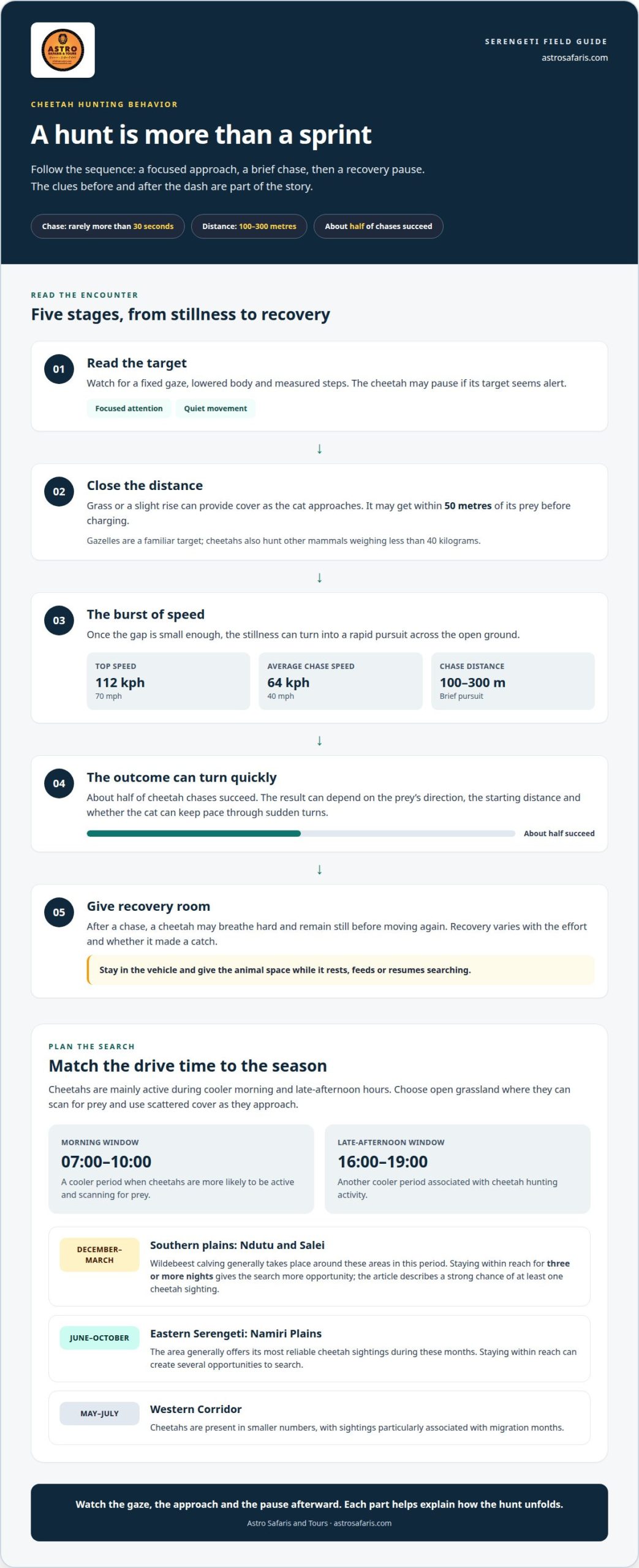
A Serengeti cheetah’s chase rarely lasts more than 30 seconds. The sprint may cover 100-300 metres, following a careful approach that can bring the cat within 50 metres of its prey. Watching cheetah hunting behavior on a Serengeti game drive means noticing the quiet approach as well as the burst of speed.
Gazelles are a familiar prey target, alongside other mammals weighing less than 40 kilograms. About half of cheetah chases succeed. The outcome can turn on the prey’s direction, the distance at the start of the charge, and whether the cheetah can keep pace through sudden turns.
Before a sprint, look for a fixed gaze, a lowered body, and measured steps toward prey. A cheetah may use grass or a slight rise for cover, pausing when its target seems alert. These clues can be subtle across open ground, so follow the cat’s attention and your guide’s interpretation. Watching a cheetah hunt during a Serengeti game drive becomes a lesson in patience and focus.
After a chase, a cheetah may breathe hard and stay still before moving again. Recovery varies with the effort and whether it made a catch. The pause is part of the hunt, not a reason to approach. Stay in the vehicle and give the animal room as it rests, feeds, or resumes searching.
When observing cheetah hunting behavior during a Serengeti game drive, the sequence matters: focused attention, a low approach, rapid movement, then recovery. The chase may pass quickly, but watching what comes before and after helps reveal how the cat uses its energy and responds to prey.
Cheetahs hunt in small groups or alone, so the animal’s company may shape what happens after a chase. In the Serengeti, cheetah siblings stay together for 6 months after becoming independent from their mother. After separating from their siblings, female cheetahs strike out on their own, while their brothers form lifelong coalitions.
The Namiri Plains area in the eastern Serengeti was closed to tourism for two decades to support cheetah population recovery. This context adds depth to observing a resting or searching cat: its social life and habitat are part of the story, beyond the brief sprint.
2. Best times of day and seasons for sightings
Time your Serengeti drives around two active windows: 07:00-10:00 and 16:00-19:00. Cheetahs hunt mainly during these cooler morning and late-afternoon hours. A morning drive can catch the plains as they brighten, while an evening outing follows the light as it softens. These windows guide planning, though a cheetah may also be resting or moving between hunting grounds.
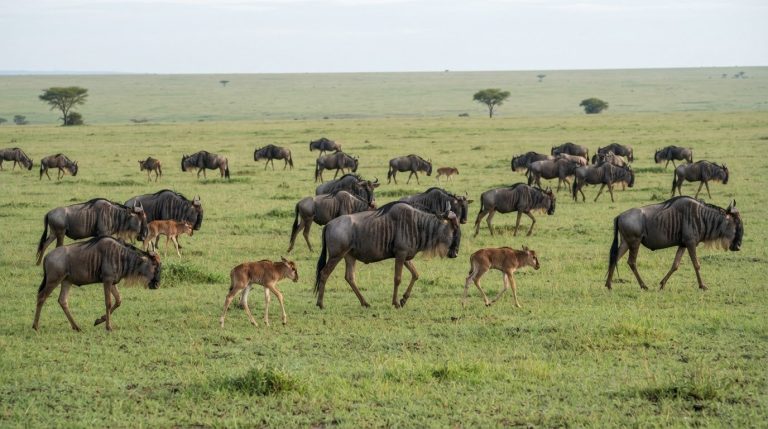
Season matters as much as the time of day. Wildebeest calving around Ndutu and the Salei area generally runs from December through March. The seasonal concentration of young wildebeest makes the southern plains a compelling place to explore. Visitors staying within reach of the southern plains during calving season have a strong chance of at least one cheetah sighting when they spend three or more nights there.
In the eastern Serengeti, Namiri Plains generally offers its most reliable cheetah sightings from June through October. Staying within reach of the area during those months can create several opportunities to look for cheetahs, rather than relying on a single drive. Wildlife and landscapes shift with the seasons, so a well-planned route can take in areas suited to your travel dates.
The Western Corridor also has cheetahs, though in smaller numbers. Sightings there are particularly associated with migration months from May through July. If those months fit your journey, the corridor may be a useful focus for your route, while Namiri Plains or the southern plains may suit other seasonal plans.
Plan around both the time of day and the calendar: choose morning or late-afternoon drives, then match the region to your dates. Three or more nights near the southern plains during calving season, or time within reach of Namiri Plains from June through October, gives the search more opportunity to unfold. Even without a hunt, scanning open ground during these periods can reveal cheetahs moving across their range.
3. Cheetah habitat and preferred hunting terrain
Across the Serengeti, cheetahs use open grassland to scan for prey and move quickly. Short grass and gently rising ground offer a clear view, while scattered vegetation can conceal an approaching cat. Watch the edges between open plains and patches of cover. A cheetah may use this contrast to stay less visible as it closes in.
Unlike lions, which can hunt as a pride, or leopards, which rely on concealment, cheetahs spot prey across open ground and pursue it directly. A cheetah watches, approaches, then accelerates when the gap is small enough. The shift from stillness to movement can be sudden, and the landscape helps explain why the cat chooses one direction over another.
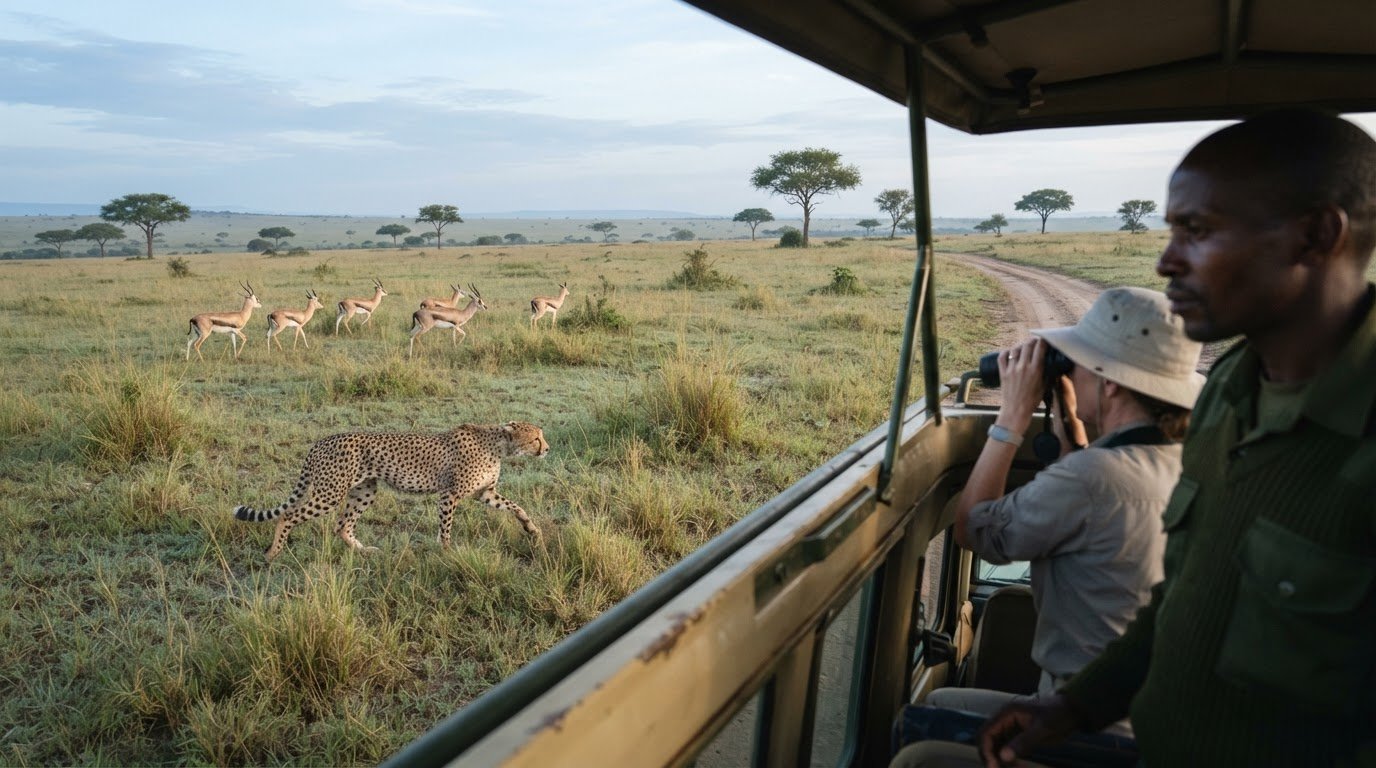
During a Serengeti game drive, follow your guide’s directions and watch from the vehicle. Quiet observation lets the guide position the vehicle without crowding the animal or obstructing its path. Keep an eye on the cheetah’s line of sight, not just its body: a fixed gaze toward gazelles can signal where a hunt may develop.
A kill can leave a cheetah vulnerable to other predators. Lions and hyenas kill a significant proportion of Serengeti cheetah cubs during their first year. This makes sightings of a mother and cubs especially sensitive. Give the family space and let your guide decide where the vehicle should remain.
Location also shapes what you may see. Female cheetahs roam widely, following gazelle migration rather than holding territories, while male coalitions are often seen crossing open grassland. Namiri Plains lies in the eastern Serengeti, and the Western Corridor can hold cheetahs in smaller numbers during migration months. Because their ranges shift, your guide may scan broad plains rather than focus on one landmark. Read the terrain with the cat: open sightlines help reveal its search, while patches of cover may mark its approach.
4. Cheetah sprint speed and stamina
A cheetah can reach 112 kph (70 mph) at top speed, while its average speed during a chase is 64 kph (40 mph). A chase rarely lasts more than 30 seconds. These figures describe a brief burst, not a pace the animal can maintain across the Serengeti.
Distance matters as much as speed. Cheetah hunting sprints typically cover 100-300 metres, and the cat must overtake prey within 200-300 metres because its stamina is limited. If prey remains beyond that range, the cheetah’s explosive acceleration may not be enough to close the gap.
For observers, the sprint is only one part of the sequence. A cheetah may first track prey and adjust its approach, then commit when the distance is short. During the chase, it changes direction to match its target’s movements. The prey’s turns and acceleration can determine whether the cheetah reaches it before its burst of energy fades.
After a chase, a cheetah needs to recover from intense exertion. Recovery has no single duration: the effort and whether the hunt ended in a catch affect what follows. Watch for the animal’s breathing and movement to settle before it resumes travelling or feeding. From the vehicle, keep observing the cheetah and its surroundings rather than assuming the action ends with the sprint.
That contrast gives a Serengeti sighting its rhythm: stillness, acceleration, then a pause. The chase reaches a peak, while its average speed reflects movement over the pursuit. After a failed attempt, the cat may return to a watchful search; after a successful one, its attention may shift to the kill and nearby animals.
For a safari planned around these fleeting encounters, plan a Serengeti game drive with the landscape and wildlife viewing in mind.
Astro Safaris and Tours
Astro Safaris and Tours Ltd can shape a Tanzania safari around your interest in cheetahs, their hunting grounds, and the seasons that influence sightings. Its Serengeti and Ngorongoro itineraries let you include game drives in a wider journey through these wildlife regions. Share your preferred travel dates, the wildlife moments you hope to experience, and the pace you have in mind.
If you plan to visit the southern plains during calving season, the Ndutu & Ngorongoro Luxury Tour may suit your journey. For a wider trip, custom safaris in Tanzania can bring your priorities into the itinerary. Cheetah hunts unfold on nature’s schedule, so thoughtful planning focuses on suitable places and time in the field, not on promising a particular encounter.
Contact Astro Safaris and Tours Ltd to discuss a Serengeti safari shaped around your wildlife interests.
Let the Serengeti Set the Pace
A thoughtful approach to watching cheetah hunting behavior on a Serengeti game drive starts with a journey shaped around your interests, travel dates, and the landscapes you hope to experience. Meaningful wildlife moments often come from allowing time to observe, rather than treating each drive as a race between sightings.
Astro Safaris and Tours Ltd can plan a Tanzania journey that connects wildlife viewing with the wider scenery. Its offerings include Tarangire and Lake Manyara National Park, Serengeti and Ngorongoro, and Tarangire, Lake Manyara and Ngorongoro Crater. Share what you want your safari to include, from patient time on the plains to exploring Tanzania’s changing landscapes.
Contact Astro Safaris and Tours Ltd to begin shaping your safari, and look forward to discovering the Serengeti at its own unhurried pace.
Frequently Asked Questions
When and where are cheetahs most active on a Serengeti game drive?
Cheetahs mainly hunt between 07:00-10:00 and 16:00-19:00. Match the region to your travel season: the southern plains around Ndutu and Salei during December through March, Namiri Plains from June through October, or the Western Corridor during migration months from May through July. For example, a January itinerary can prioritize the southern plains, while a September route can focus on the eastern Serengeti.