How to Compare Tanzania Safari Quotes and Understand the Total Price
The lowest headline price may not offer the best value for your journey. To learn how to compare Tanzania safari quotes, look beyond the total and check whether the trip is private or shared, what accommodation standard is included, and what the itinerary says about guiding and reviews. Compare these details across the same route to see what each quote really covers.
It’s natural to focus on price first, especially when you’re picturing long days beneath the Serengeti sky or a quiet evening near Ngorongoro. But accommodation, pace, comfort, and guiding all shape what that price includes. This guide explains how budget, mid-range, and luxury safaris can differ, what to look for in guest reviews, and which inclusions help you understand the full trip cost, so you can choose a safari that matches the experience you have in mind.
Key Takeaways
- Compare safari quotes by matching what each itinerary includes, not just the headline total.
- Consider how vehicle sharing affects privacy, flexibility, and the rhythm of your days in the parks.
- Use details in guide reviews, such as wildlife tracking and animal-behaviour interpretation, to assess the experience behind the price.
- Match the accommodation category and trip style to the comfort, pace, and level of service you want.
1. Private versus shared group safari pricing
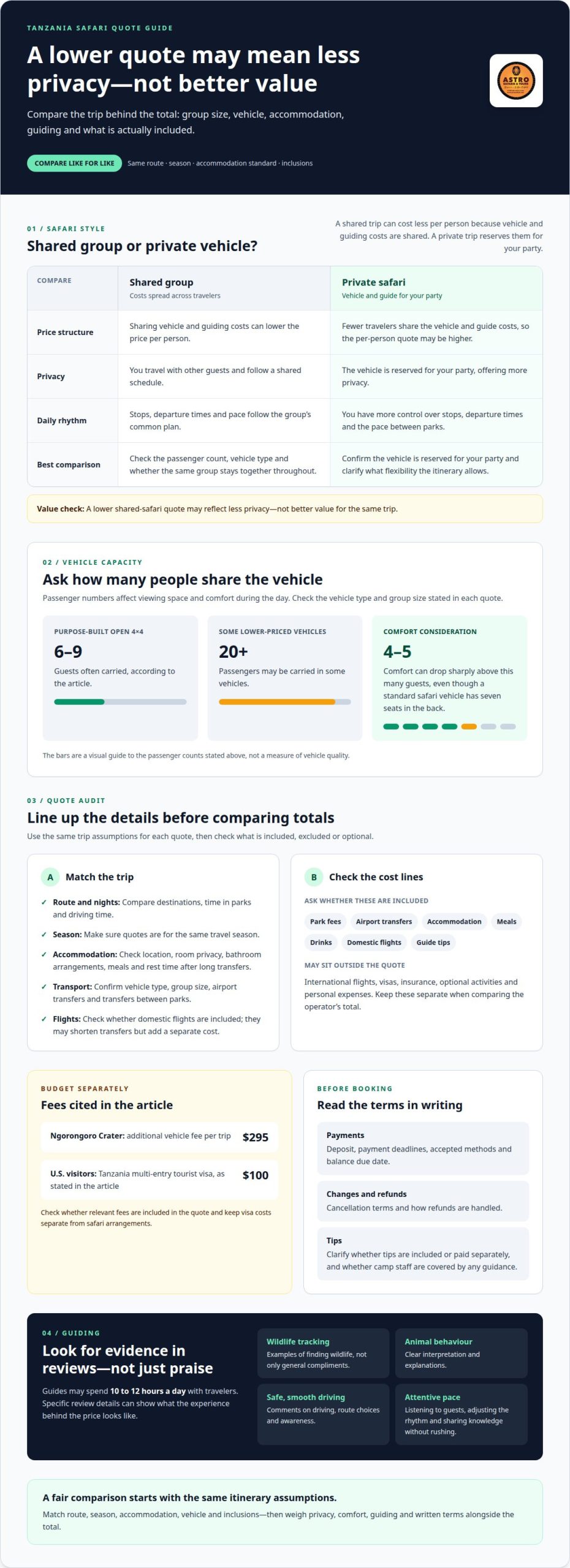
On a shared safari, travelers share vehicle and guiding costs, which can lower the price per person. A private safari reserves the vehicle and guide for your party, giving you more control over stops, departure times, and the pace between parks. Compare both options using the same route, season, accommodation standard, and inclusions. A lower shared-safari quote may reflect less privacy, rather than better value for the same trip.
Vehicle capacity matters on the ground. Purpose-built open 4×4 vehicles often carry six to nine guests, while some lower-priced safaris use vehicles carrying 20 or more passengers. A standard safari vehicle has seven seats in the back, and comfort can drop sharply with more than four or five guests. Ask for the vehicle type and the number of travelers sharing it; then assess how those seats affect viewing space and the day’s travel.
To compare vehicles, group sizes, and guiding, check the vehicle type and passenger count stated in each quote. While tour operators provide dedicated safari transport, travelers curious about the rugged 4×4 models commonly driven on Tanzanian roads can browse local listings on ShowroomPal to see vehicles suited for this terrain. Read reviews for specific comments on wildlife tracking and animal-behaviour interpretation. A private vehicle offers more flexibility, while a shared group can suit travelers who are happy to follow a common schedule.
Transfers can also change the comparison. Establish whether airport or other transfers are included, and whether the same group stays together throughout the safari. For United States visitors, Tanzania Immigration Services Department states that a $100 multi-entry tourist visa is required for Tanzania. Keep this separate from the operator’s quote so your trip budget reflects both safari arrangements and travel documentation.
Cancellation, deposit, and payment terms should spell out the deposit, payment deadlines, accepted methods, balance due date, and how cancellations and refunds are handled. Compare these terms alongside the itinerary. Two shared trips with similar routes can differ in payment timing and cancellation terms.
2. How Much Will Your Tanzania Safari Cost?
A Tanzania safari quote reflects travel style, accommodation, route, season, and included services. Budget, mid-range, and luxury categories can differ in lodge location, privacy, meals, and comfort after long drives. On a private safari, fewer travelers share the vehicle and guide costs; on a shared trip, those costs are spread across the group. To compare Tanzania safari quotes fairly, first align the itinerary and inclusions.
Accommodation standards affect comfort and the rhythm of each day. Lodges inside or near a national park can reduce time spent traveling to wildlife areas, while stays outside major parks may mean more driving. Room privacy, en-suite or shared bathrooms, meal arrangements, and time to rest after a long transfer also help distinguish a simpler stay from a more refined one.
Northern and southern circuits involve different transport needs. Serengeti, Ngorongoro, Tarangire, and Lake Manyara are common northern destinations, while longer distances on southern routes can increase ground transport costs. Domestic flights may shorten transfers, but add a separate cost when included. Comparing Tanzania safari quotes also means weighing driving time, nights in parks, and transfer arrangements, not just the number of destinations. Reviewing itineraries from local operators such as kilimanjaroselect.com can help you see how these logistics and park visits are typically scheduled.
Park fees are another major part of a safari total. Visiting the Ngorongoro Crater has an additional vehicle fee of $295 per trip, according to Ngorongoro Conservation Area Authority. A quote should show whether park fees, airport transfers, domestic flights, accommodation, meals, drinks, and guide tips are included. International flights, visas, insurance, optional activities, and personal expenses may sit outside the quoted total.
Extra costs can arise when an itinerary leaves out an inclusion or lists it as optional. Compare the trip components in writing, including transfers between parks and any flight connections. Safari prices vary with route, travel style, accommodation, group size, and inclusions, so compare the details of each quote rather than relying on the total alone.
For an itinerary built around your preferred route and comfort level, explore custom safari planning.
3. Guide experience and reviews
A skilled guide adds interpretation to the wildlife visible across the Serengeti plains. Safari guides may spend 10 to 12 hours per day with travelers, so communication and patience shape the experience as much as animal sightings. Compare reviews for concrete examples: tracking skill, clear explanations of animal behaviour, safe driving, and thoughtful responses to guests. Specific stories carry more weight than general praise.
Look for reviews that describe the guide’s role throughout the trip, not just a memorable sighting. Feedback about finding wildlife in Tarangire or explaining animal behaviour gives you a clearer sense of the guiding style. Notice whether reviewers mention listening to guests, adjusting the pace, and sharing knowledge without rushing. These details say more about attentive guiding than praise focused only on scenery.
A driver-guide’s experience matters because the same person may drive and interpret the destination. Look for comments about smooth driving, route decisions, awareness of the vehicle, and spotting wildlife while keeping attention on the road. Reviews covering different stages of a journey can also reveal consistency, especially on a route that includes both Tarangire and Serengeti.
Set tips apart in your safari budget. Quotes and booking documents should clarify whether tips are included or paid separately, and whether any guidance covers camp staff as well as the driver-guide. A tip is separate from the quoted service description and should be considered as its own planned expense.
Use a simple review comparison: identify recurring comments, relate them to the guide’s responsibilities, then consider how they fit your preferred itinerary. If you value patient wildlife interpretation over a fast-moving schedule, prioritize reviews describing careful tracking and unhurried explanations. For a Serengeti-focused trip, feedback about guiding there is more relevant than praise unrelated to your route. This helps bring the human side of a safari quote into focus.
4. Safari prices by budget, mid-range, luxury, and ultra-luxury categories
Budget, mid-range, luxury, and ultra-luxury describe different combinations of accommodation, guiding, meals, privacy, and pace. These labels are not universal standards, so compare what each category includes on your route. A budget stay near Tarangire may prioritize practical comfort, while a higher category may emphasize privacy, attentive service, and time to recover after a long drive.
Mid-range safaris often balance comfortable lodges with a practical itinerary. Compare each property’s location, the amount of driving in the schedule, and whether meals and transfers are included. In Serengeti and Ngorongoro, lodge location can affect how quickly you reach wildlife areas and how much time remains for game drives. The category label alone won’t tell you these details.
Luxury can mean more than an elegant room. Consider the complete experience: accommodation location, meals, guiding pace, privacy, and time to rest between drives. A slower itinerary with well-placed lodges may feel more premium than a packed list of parks. In Ngorongoro, for example, compare how the schedule balances crater visits, road time, and downtime.
Ultra-luxury quotes may include optional services such as helicopter transfers or spa treatments. These can increase the safari cost without changing the core wildlife itinerary. Separate essential elements from optional extras, then compare like with like: accommodation standard, guiding, included transport, meals, and activities. That makes it easier to judge whether the added comfort suits your priorities.
For a clear decision, write down the experience you value most, such as private space, a slower pace, or refined accommodation. Then match each quote to those priorities instead of relying on category names. If you’re shaping a journey around comfort and wildlife, plan your Tanzania safari around the style that suits you.
Astro Safaris and Tours
Astro Safaris and Tours Ltd helps travelers shape a Tanzania itinerary around their route, travel style, and preferred level of comfort. If you’re comparing park combinations or choosing between a practical stay and a more refined one, the team can tailor a safari to those priorities.
Choose a route that reflects the experience you want, from Tarangire and Lake Manyara to Serengeti and Ngorongoro. For a comfort-focused journey, the Ndutu & Ngorongoro Luxury Tour offers another itinerary to consider. Clear priorities make it easier to bring destinations, accommodation style, and pace together in one trip plan.
Share your preferred route and safari style with Astro Safaris and Tours Ltd to discuss a Tanzania journey tailored to you.
Shape a safari that feels like yours
A quote comparison can lead to more than a decision between totals. Use what you’ve learned about how to compare Tanzania safari quotes to define the kind of journey you want: a particular landscape, a gentler rhythm, or a more intimate way to experience the wilderness. One clear priority can help shape an itinerary that feels personal rather than assembled from a checklist.
Astro Safaris and Tours offers journeys to Tarangire and Lake Manyara National Park, Serengeti and Ngorongoro, and Tarangire, Lake Manyara and Ngorongoro Crater. Each route offers a different way to imagine the days ahead, from open plains to crater landscapes. Let your preferred destinations guide your plans, then consider which pace and travel style suit your companions.
Take the next step when you’re ready to turn your priorities into a Tanzania safari plan. Contact Astro Safaris and Tours to begin shaping a journey worth remembering.
Frequently Asked Questions
How Much Will Your Tanzania Safari Cost?
The total depends on your route, travel style, accommodation, and what the itinerary includes. Compare quotes for the same destinations and travel dates, then separate core trip costs from optional spending. A safari that includes more services may have a higher total but fewer expenses to arrange separately. Priorities such as privacy or lodge comfort can help you decide which quote fits best.
How Long Will You Drive Each Day?
Driving time depends on your route and overnight stops. Reaching the central Serengeti by road can take a full day, so an itinerary with that transfer needs enough time in its schedule. Compare each day’s planned driving with its park activities and overnight stop. Destination order matters too: changing the sequence can alter how much time you spend on the road.
How Many People Share the Vehicle?
Group size varies by safari, so distinguish the travelers in your booking from the full vehicle group. A shared trip may bring together guests who booked separately, while a private trip reserves the vehicle for your party. Check the maximum passenger count and seat allocation in the itinerary. Also note whether transfers use the same vehicle and group as the game drives.
How Much Extra Budget Should You Set Aside?
Base your extra budget on the quote’s exclusions rather than adding an arbitrary percentage. Make separate allowances for personal purchases, meals or drinks listed as excluded, optional activities, tips, and payment charges if applicable. Mark each item as required or optional. This helps avoid counting an included service twice and keeps discretionary spending separate from safari arrangements.
How do I know the lodges are as described?
Match each accommodation listing to the property name, room category, and meal arrangement in your itinerary. Look for the exact lodge or camp assigned to each night rather than relying on broad labels such as “mid-range.” Check that the room description suits your needs, including its bathroom arrangements and location. Written details make it easier to compare the planned stay with the accommodation described.
Is the Operator Licensed and Easy to Reach?
Ask for the operator’s registered business name and relevant tourism licence details, then check that the contact information and booking documents consistently use that name. Clear communication channels and written responses about itinerary changes, payments, and trip arrangements help you assess how the operator handles your booking. Keep these details with your records. A polished review or attractive itinerary alone doesn’t establish licensing or reliable communication.